Connect
Optical Interconnect for the Next Generation of AI Infrastructure
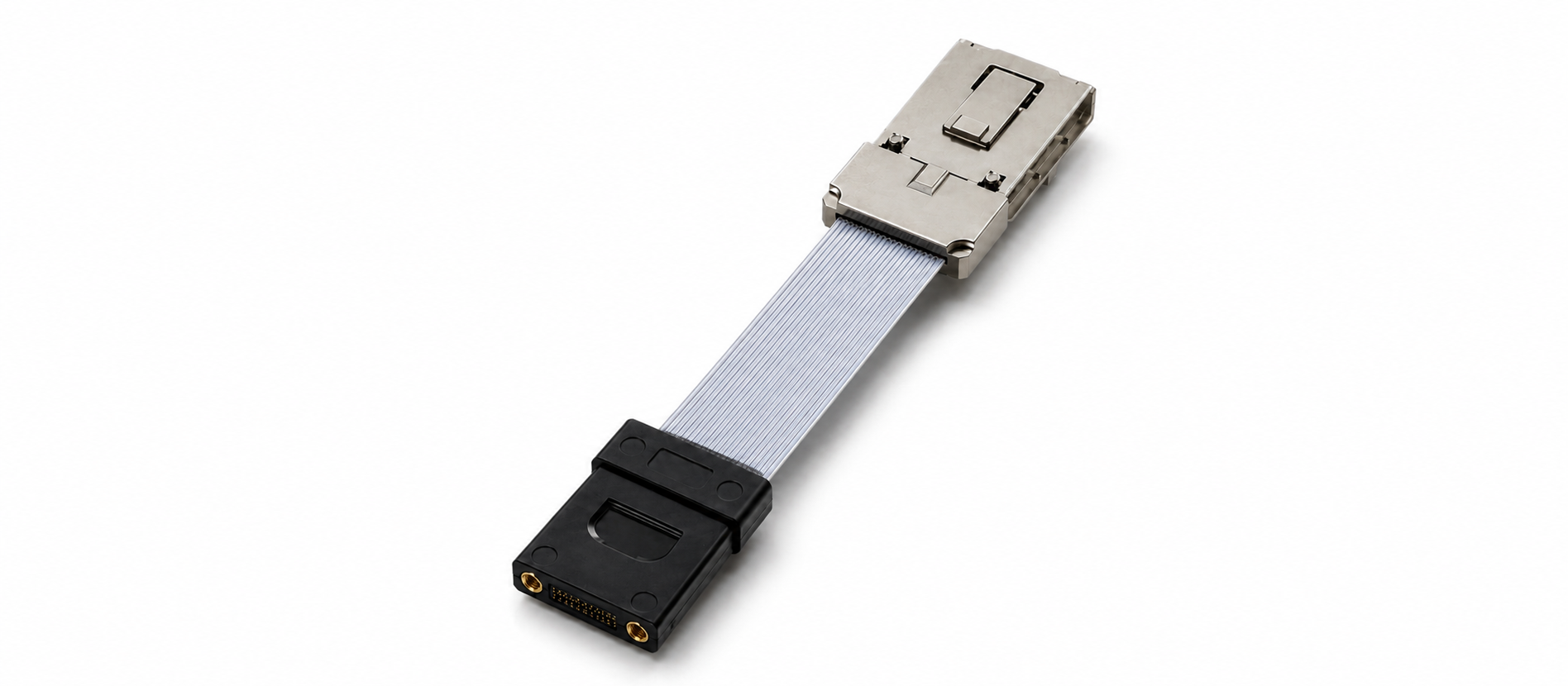
Artilux Connect Series is a next-generation optical interconnect platform built for AI infrastructure, powered by Artilux's proprietary GeSi optoelectronic technology. Scale-out and scale-up networking pose different challenges — one favors high bandwidth and long-reach, while the other favors power efficiency and low latency. Connect Enterprise meets each with a purpose-built solution rather than a one-size-fits-all approach. This delivers high modulation rates for server links across racks, and high energy efficiency for GPU links inside AI clusters.
The foundation of
next-generation AI data centers
Modern AI workloads demand not only faster processors, but also cohesive, well-matched interconnections between every component in the system: CPUs, GPUs, memory, and networking equipment. As data movement increasingly dominates overall system performance, optical interconnect has become a critical technology for scaling AI infrastructure. That need shows up at every level — chip-to-chip, board-to-board, rack-to-rack, and beyond — each with its own distance and bandwidth demands, but all pointing to the same underlying challenge: minimizing latency, maximizing bandwidth density, and optimizing energy efficiency.
Dense, high-throughput links engineered for both long-reach scale-out and short-reach scale-up.
Optimize communication energy per bit, so power scales with compute instead of against it.
Matrix delivers the low-latency performance that GPU-to-GPU communication inside AI clusters demands.
Two dedicated architectures — Flash for scale-out, Matrix for scale-up — compatible with co-packaged optics and next-gen accelerators.
One platform,
two AI architectures
Unlike one-size-fits-all optical solutions, Connect provides two purpose-built interconnect technologies — each matched to the distinct demands of scale-out and scale-up AI networks.
"Narrow & Fast" Optical Interconnects for AI Scale-Out Connectivity
Flash™ is optimized for high-modulation rate, long-reach communications across AI data centers. Powered by our proprietary GeSi electro-absorption modulator (EAM), it delivers ultra-high-modulation-bandwidth with excellent thermal stability. Our innovations establish a new foundation for energy-efficient, high-bandwidth optical links that seamlessly connect processors, memory, and accelerators. Designed for AI systems, data centers, and co-packaged optics (CPO), this architecture drives the transition from electrical to photonic interconnects—paving the way for a faster, greener, and more scalable computing future.
"Wide & Slow" Optical Interconnects for AI Scale-Up Connectivity
Matrix™ is designed for short-reach communications inside AI accelerator clusters where energy efficiency and latency are paramount. By deploying massively parallel and scalable GeSi photodetector arrays, Matrix delivers enormous aggregate throughput. The lower data modulation rate reduces or eliminates electronic digital processing, resulting a low-latency, low-power interconnect. Optimized for scale-up applications such as processor-to-memory, chiplet-to-chiplet, and in-package optical interconnects, this architecture bridges the gap between electrical and photonic domains with compact form factors, minimal heat dissipation, and CMOS-compatible manufacturability. By embracing optical parallelism at the component level, Artilux is enabling the next generation of high-density, energy-aware computing modules.
Flash™ vs. Matrix™ side by side
| Spec category | Flash™ (GeSi EA Modulator) | Matrix™ (GeSi PD/APD Arrays) |
|---|---|---|
| Primary goal | Bandwidth & Reach | Energy efficiency |
| AI architecture fit | Scale-out (CPU–CPU / NIC / switch) | Scale-up (GPU–GPU, accelerator clusters) |
| Typical reach | Long-reach links (rack-to-rack / cross-cluster) | Short-reach links (on-board / module-to-module) |
| Interconnect architecture | Narrow & Fast | Wide & Slow |
| Per-device modulation BW | >150 GHz per channel (RC limited) | 2–32 Gbps per channel |
| Footprint (active device) | ~15 µm (small) | Array elements configurable; typical PD/APD pitch 10–50 µm |
| Energy efficiency (system) | Target 2.5-3.5 pJ/bit for high speed links | <1 pJ/bit |
| Optical wavelength range | O-band & C-band | Visible, NIR, SWIR |
| Temperature range (operation) | Nearly insensitive from 35–85 °C | 120°C |
| Thermal stability | Very stable; no heater or tight cavity control | High tolerance to elevated GPU-adjacent temperatures |
| Manufacturing control | No advanced litho/etch required, higher yield | Mature CMOS 12″ wafer, hybrid-bonded to ASIC; customizable array geometry |
| Dark current | N/A (modulator) | >3 orders of magnitude lower than other Ge PD/APD |
| APD breakdown voltage | N/A | <10V; easy driver integration, reduced system power |
Optical interconnects
for the AI-Scale future
Most optical interconnect solutions focus on only one networking challenge. Connect Enterprise uniquely addresses different major communication layers of modern AI infrastructure:
Flash™ accelerates high-speed networking across AI data centers.
Matrix™ minimizes power consumption inside AI compute clusters.
Together, they provide a complete optical interconnect platform that helps AI infrastructure achieve higher bandwidth, better energy efficiency, lower latency and greater scalability as AI workloads continue to expand.